

Is Reality Simulated?
Different Roads to the Exact Same Place

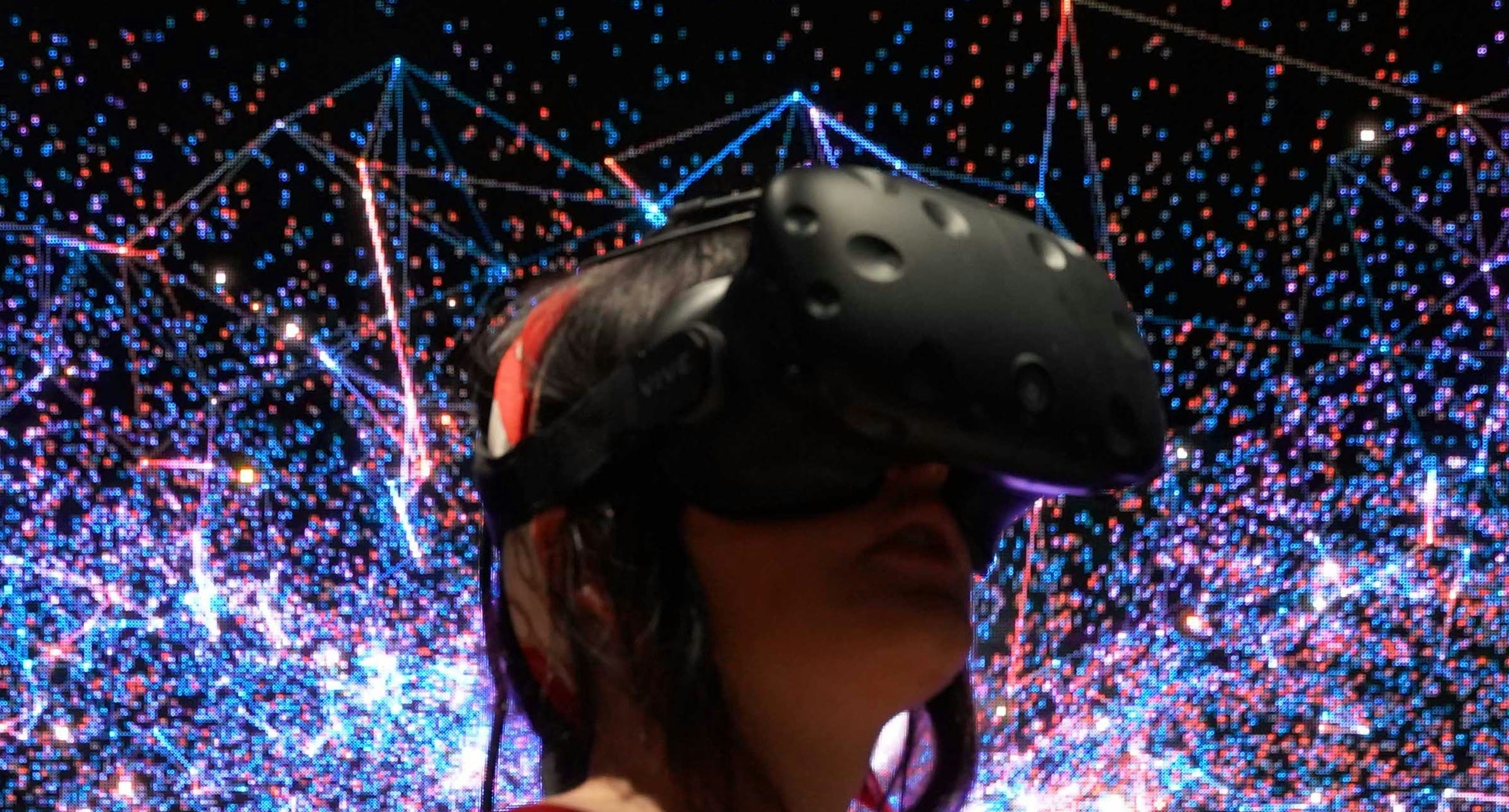
(Photo by Sara Kurig on Unsplash)
There’s a strange moment, occasionally, when two completely different lines of inquiry - two lives, even - turn out to be tracing the same underlying pattern. You’re busy following your own trail, head down, convinced you’re working away all alone on your own little island, only to look up and see someone else walk into the same clearing from the opposite direction.
That happened to me when I met Rizwan Virk on the shores of Lake Maggiore in Italy at the Sol conference that I wrote about here a couple of weeks ago, a forum where technologists, scientists, and writers gathered for two days of open-ended discussion about the UAP/UFO phenomenon.
I’d known of Riz and his work - The Simulation Hypothesis, The Simulated Multiverse - but I hadn’t actually sat down with him until we bumped into each other on Sol Day 3. I liked him immediately – and it helped that he knew about me, having many years ago read my book The Hunt for Zero Point.
He has an easy calm that often shows up in people who’ve spent years building things - actual things, games and systems in his case, not just theories. He talks the way engineers think and is the kind of person who takes the world apart mentally and inspects the joints - something I like to do too.
At the time, I didn’t realise we were approaching the same idea from completely opposite ends of the map.
It only became obvious in the days following Sol, in fact, after I’d got into The Simulated Multiverse and thought about my ongoing project here on Substack, The Outlier Series - on near-death experiences (NDEs), psi, psychedelics, UAPs, plasma phenomena, and the class of experience I’ve been calling interface anomalies – stuff that science says shouldn’t appear on the ‘screen of our perception’, but does.
And that’s when I saw the convergence, the shared conclusion neither of us was trying to reach.
We’d both arrived at a simulation model.
Just not the same way, and not the same kind of simulation.
Two paths that shouldn’t have met
If you’d asked me ten years ago whether I’d ever be writing sentences like that, I would have laughed. I was a defence journalist, rational, sceptical, grounded in hard reporting and harder evidence (I still am). I didn’t do metaphysics. I didn’t do consciousness. I certainly didn’t do simulation theory.
And that’s precisely why I trust where the inquiry has taken me. Because I didn’t want to end up here.
My route was the furthest thing from speculative philosophy. It came from the accumulated gravitational pull of ‘outliers’: things that shouldn’t happen but do; the experiences that break the model; the events that materialism shrugs at because they don’t fit within its neatly prescribed filing system. I didn’t chase them - they chased me, often against my will.
You can only ignore so many cracks in the façade before you start asking whether the façade is the problem.
Riz, meanwhile, came at it from inside the logic of creation - the literal creation of digital worlds.

A computer scientist by training - MIT for undergrad, Stanford for his master’s, and now a PhD candidate at Arizona State University - he’s best known for building and investing in hit videogames (his own titles have been downloaded millions of times) and for founding Play Labs @ MIT, a startup accelerator at the intersection of gaming, VR, and AI. He’s also an active angel investor, backing companies like Discord, Tapjoy, and PocketGems. In short, he had spent years designing games, thinking about rendering limits, NPC behaviour, and probabilistic environment updates.
(In gaming terms, ‘rendering limits’ refers to a basic optimisation trick: the system never draws the whole world at once. It only renders what the player can see or interact with; everything outside the player’s field of view stays low-resolution or dormant until needed. It’s a way of managing computational load - and it echoes, uncannily, some of the behaviours we see in physics, where detail seems to ‘appear’ only when observed.)
(‘NPCs’ - non-player characters - are the background characters whose behaviour is driven by simple scripts. They aren’t ‘real,’ but they respond to players as if they have agency. It’s one of the simplest ways to create the illusion of life in a simulated world.)
(‘Probabilistic environment updates’ are another optimisation method. Instead of keeping every part of the world in a fixed, pre-determined state, many games leave elements undecided until the player interacts with them - filling in details using probabilities. This makes the world feel alive and dynamic, and it mirrors what quantum physics seems to do when outcomes only ‘collapse’ into a definite state upon observation.)
He approached the problem of reality like someone who had already built small universes and was now trying to understand whether ours operated in a similar way.
And of course, once you start thinking this way, an uncomfortable question follows. If our world behaves like a simulation, then we aren’t the game designers - we’re the players, or worse, the NPCs inside it. That doesn’t mean we lack agency; NPCs in complex simulations can still respond, adapt, and even surprise their creators. But it does mean the frame shifts. It means we’re embedded inside a system whose full architecture we can’t see, governed by rules we didn’t write. And that leads to the question that haunted me throughout The Light Beyond the Mountains: if we’re the ones inside the rendering, then who - or what - is running the game?
So, long story short, I was wrestling with UAP metadata and Riz was wrestling with why the grass in some videogames renders only when the player looks at it.
Different careers.
Different obsessions.
Different lived experiences.
And yet, somehow, we ended up coming to the same conclusion.
What I saw following the anomalies.
As anyone following The Light Beyond The Mountains and The Outlier Series will know, my route wasn’t computational. It was phenomenological. It started with things that should not exist:
telepathy-like information transfer
remote viewing accuracy that beat chance by absurd margins
NDEs where patients without measurable brain function reported verifiable details
psychedelic encounters that presented coherent informational agency
orb-like plasma formations behaving as if aware of observers
UAPs performing manoeuvres that violate known physics
coherent ‘apparitional’ events in high-entropy environments
spontaneous healing events characterised by sudden, inexplicable order
If you force yourself to stay empirically grounded - if you refuse the easy escape hatch of ‘hallucination’ or ‘misperception’ when the data clearly doesn’t support it - you eventually run out of room.
The anomalies aren’t random.
They aren’t noise.
They cluster.
They form patterns.
They respond to attention.
They behave informationally.
Eventually you have to ask: what kind of world produces these behaviours?
And the only answer that fits is a rendered world, an interface world, a world where consciousness isn’t produced by the hardware of the brain - it’s interacting with it.
Not because that idea is attractive. But because the empirical anomalies force you there.
What Riz saw from inside the code
Riz arrived at almost the same point from a completely different angle.
Where I saw ‘interface leaks’, he saw things that, to a game designer, look familiar - not metaphorically familiar, but practically so. Behaviours he had seen before in the worlds he built.
For example:
· Render budgets: games don’t render everything at once; they only render what the player can see to save computational load.
In physics, this echoes the quantum observer effect, where certain properties only ‘snap into place’ when measured.· Conditional objects: assets appear only when triggered or observed.
This resembles how unobserved quantum states remain probabilistic until an interaction forces them into a definite outcome.· NPC behaviour patterns: simple rules that produce complex, lifelike responses.
In real life, this is a bit like how simple habits or instincts can generate surprisingly sophisticated human behaviour.· State restores and branching timelines: common in multiverse-style games where the system tracks different potential paths.
This parallels the Many Worlds Interpretation of quantum mechanics, where reality may carry multiple potential states until one is experienced.· Synchronicities: events that align with scripted precision, the way a game nudges a player into a path without making it obvious.
Experientially, this mirrors those uncanny moments where external events seem to arrange themselves meaningfully around inner states.
To me, these were data anomalies - ‘rogue icons’ on the interface. Signs that the perceptual layer was behaving in a way Donald Hoffman - we’ll come to him soon - might call non-veridical.
To Riz, they looked like engineering signatures - behaviours you get when a system is balancing resources, hiding complexity, and updating reality only when needed.
Importantly, he didn’t arrive at the simulation hypothesis through Nick Bostrom - though Bostrom’s work is central to the contemporary debate. (Bostrom, a philosopher at Oxford University, famously argued that future civilisations will likely run ancestor-simulations, making it statistically probable we’re in such a simulation now.)
Riz came to it first as a builder. He followed the internal logic of systems - how they optimise, how they scale, how they create illusions of continuous worlds out of limited memory. He wasn’t trying to construct a cosmology or a grand theory of everything. He was simply applying the instincts of a systems designer to the world around him: watching how things behaved, looking for constraints, bottlenecks, and patterns, just as he would when debugging a game or tracking how a virtual environment actually runs.
He was looking at our reality the way an engineer looks at a running system - and some of the behaviours were suspiciously familiar.
The exact point where the two paths meet
The convergence doesn’t lie in language - it lies in architecture.
Both Riz and I, in our own ways, were forced to recognise that the world behaves - contrary to what orthodox science tells us is ‘real’ - as if:
Perception is an interface, not a window onto objective reality.
Information is primary; matter is a rendered output.
The universe updates or responds based on attention, entropy[1], and coherence[2].
There is agency in the system - not always visible, not always comprehensible, but consistent.
Reality is not fixed; it is conditionally rendered.
Experience can override physics under certain conditions.
The architecture learns - from us, through us, with us, via feedback[3].
Again, this isn’t a philosophical convergence. It’s an empirical one.
We didn’t start from the same assumptions or follow the same evidence.
And yet we arrived at the same structural view.
That’s what struck me – and is what this piece is about.
Not ‘the world is a simulation’ - although that is where the compass points - but the robustness of a conclusion reached independently from entirely different domains of evidence.
A simulation - but not a dead one
Here’s the important part, and where personal experience enters the story.
