



(Photo by Jacek Smoter on Unsplash)
For the better part of a decade, the argument over UAP disclosure has revolved around a surprisingly simple assumption: that whatever the US government is protecting, the secret must lie principally in the things themselves.
Depending on where you stand in the debate, those things might be experimental aircraft, advanced foreign weapon systems, recovered vehicles of unknown origin or evidence of a non-human intelligence operating somewhere in our environment. The extraordinary secrecy surrounding the subject is generally taken to mean that somewhere behind the classified wall lies an answer to the question people have been asking since the beginning of the modern UFO era: what are they?
It is a reasonable assumption. But there may be another way of looking at the problem.
While researching the history of some of the institutions sitting at the intersection of advanced physics and US national security, I have found myself increasingly interested in a different question. What if, for at least one category of UAP, the sensitivity lies partly in the explanation itself? What if telling us what these phenomena are would require the Pentagon to disclose what it has learned about the physics that produces them – knowledge accumulated across decades of classified research and now embedded in technologies of considerable military importance?
That possibility does not require every UAP to have the same explanation. Almost certainly they do not. My interest here is narrower: recurring reports of luminous, sometimes roughly spherical or orb-like phenomena displaying unusual optical, radar or electromagnetic characteristics.
There are many possible explanations for such observations, and I am not proposing to settle that question here. Instead, I want to follow one particular strand of physics that turns up with surprising regularity in the history of US defence research: plasma.
The question is whether some of the classified material surrounding UAP might intersect with a much older body of defence science whose sensitivity extends far beyond UFOs. If certain anomalous phenomena involve physical effects that the United States has spent generations learning to generate, manipulate or exploit, opening the UAP files could potentially expose relationships between technologies whose military value remains very real.
Which leaves us with a rather different disclosure question:
What classified physics might be exposed if the US government told us what some UAP actually are?
The Fourth State Hiding in Plain Sight
Plasma is one of those things most of us vaguely remember from school physics. Heat a gas sufficiently and its atoms begin to lose electrons, producing an electrically charged mixture of ions and electrons: the fourth state of matter. Stars are made of it. Lightning produces it. Most of the visible universe consists of it.
The US defence establishment thinks about it rather more.
Plasma affects the propagation of radar and radio signals through the atmosphere and ionosphere, making it important to communications, navigation and sensing. It is integral to nuclear fusion and high-energy-density physics, generated by nuclear explosions and therefore central to understanding nuclear-weapons effects and EMP[1]. It runs through intense particle beams, high-power microwaves, pulsed-power systems (see the time-lapsed image of the Z pulsed power accelerator at Sandia below) and directed-energy weapons. At hypersonic velocities, ionised gases form around vehicles; higher in the atmosphere, plasma becomes part of the operating environment for satellites, missile warning, radar and military operations in space.
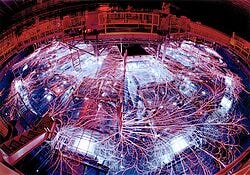
Seen separately, these appear to be different branches of defence science. Underneath them lies a considerable amount of common physics.
The US Naval Research Laboratory provides a striking illustration. Its Plasma Physics Division works across space and laboratory plasmas, intense electron and ion beams, pulsed power, nuclear-weapons effects, inertial-confinement fusion and advanced radiation sources. NRL has also spoken openly about modifying space plasmas[2] for ‘strategic effects’ relevant to communications, satellite navigation and radar.
There is nothing clandestine about this. What is striking is the breadth of capability gathered beneath a word that, outside specialist circles, carries little strategic resonance.
A physicist investigating how an intense beam propagates through an ionised medium may appear to inhabit a different world from an engineer studying communications disruption in the ionosphere, or a weapons scientist generating extreme electromagnetic conditions through pulsed power. Their programmes and immediate objectives differ, but at a deeper level they can be exploring different manifestations of the same physical landscape.
Looking for a single ‘plasma programme’ therefore makes little sense. The more interesting question concerns what generations of defence researchers have learned plasma can be made to do.
The Secret isn’t Plasma
Plasma physics is an established scientific discipline, pursued openly around the world. If there is something hidden here, we need to be precise about what it might be.
There is a useful historical precedent. During the early Cold War, the United States conducted its controlled thermonuclear fusion research under the classified Project Sherwood. Scientists at Los Alamos, Princeton, Livermore and elsewhere were trying to understand how extraordinarily hot plasma might be confined long enough to sustain fusion. Much of the work was eventually declassified, helping to seed the open field of plasma physics that followed.
The underlying science becoming public did not remove its military consequences.
I encountered a similar distinction years later in a very different field. Ben Rich (below), the legendary former head of Lockheed’s Skunk Works, once told me that during the early development of stealth there had been discussion about whether the underlying physics should effectively be buried before they even knew whether they could apply it to a workable aircraft. Stealth depended heavily on controlling how electromagnetic energy interacted with an aircraft, using shaping and materials to reduce the radar energy returned towards a hostile receiver.

Rich’s point stayed with me because it revealed something about disruptive defence science. A weapon can be protected by classifying the weapon. A physical principle, or an unexpected application of an existing one, presents a harder problem. Once people understand the principle, they can begin imagining applications of their own.
Suppose, over decades, defence scientists discovered that particular plasma states and their interaction with electromagnetic fields had useful consequences across radar, nuclear effects, high-power microwave systems, particle beams, communications, directed energy and the ionosphere. Each application could develop within its own programme, institution, technical vocabulary and security classification.
No grand decision to ‘hide plasma’ would be necessary. The strategically important knowledge could simply become distributed among the applications to which it gave rise.
We might, I suppose, call this ‘strategic fragmentation’.
Over time, related science starts to look like unrelated specialist disciplines. Plasma becomes fusion in one laboratory, space weather in another, nuclear effects elsewhere, pulsed power in another programme, radar propagation in another, directed energy in another.
In other words, the branches remain visible; what becomes harder to see is the tree.
The question that interested me – especially in the context of the UFO disclosure era – was this: how do you ensure this particular tree stays hidden within the forest, indistinguishable from other trees?
When Plasma Went to War
By the late 1950s, the nuclear age had begun extending upwards into the atmosphere and space, bringing the realisation that a high-altitude nuclear explosion could create vast artificial plasma disturbances. These could interfere with radio communications and radar, alter the ionosphere and threaten spacecraft. Plasma had become a large-scale electromagnetic environment with direct military consequences.
For NRL, this fell onto fertile ground. The laboratory had spent decades working on radio propagation, radar and the ionosphere and was already deeply involved in the emerging science of space. In 1966, it created a dedicated Plasma Physics Division, bringing together magnetic fusion, nuclear effects, space plasma physics and the propagation of intense light and particle beams through the atmosphere.
The grouping is revealing. Problems that could be described as separate military disciplines were being placed together because their underlying physics was closely related.
The consequences spread. Reproducing the extreme radiation environments created by nuclear weapons required machines capable of releasing enormous amounts of electrical energy in extremely short bursts. In 1968 NRL built Gamble I, a high-power pulsed-power generator developed to simulate nuclear-weapons effects. Pulsed power subsequently opened routes into intense electron and ion beams, X-ray generation, plasma radiation sources, Z-pinch research[3] and high-energy-density physics.
This is how defence science grows. A solution to one military problem creates an experimental capability; that capability reveals another physical effect; somebody recognises a different application.
By the end of the 1960s, plasma had entered the defence establishment as a medium through which nuclear effects, electromagnetic propagation, intense energy, space and weapons research could increasingly intersect.
One scientific root system was producing an extraordinary number of military branches.
The Possibility Engine
Another institution had entered the story in 1958, created in response to Sputnik. The Advanced Research Projects Agency – ARPA, later DARPA[4] – was intended to prevent the United States being surprised again by a technological breakthrough.
One of its earliest projects takes us directly into this story. In 1959, Cornell University signed a contract with ARPA to study an enormous ionospheric radar instrument in Puerto Rico. Four years later it opened as the Arecibo Ionospheric Observatory. Although it became famous for radio astronomy, its development had initially been funded through Project DEFENDER, ARPA’s ballistic-missile-defence programme, and included studying the upper ionosphere and its interaction with electromagnetic signals.
The military logic was clear. A ballistic missile travelled through an ionised environment, while systems intended to detect and intercept it depended upon radar propagating through that environment. ARPA was simultaneously pioneering electronically steered phased-array radar for missile defence and space surveillance.
The missile-defence problem was therefore drawing together radar, space surveillance, electromagnetic propagation and the ionosphere while plasma and high-energy physics developed elsewhere across the defence establishment.
ARPA occupied a distinctive position in this landscape. Laboratories could accumulate deep expertise in particular physical regimes; ARPA’s purpose was to ask what strategically useful capability might emerge if promising science were pushed further and faster. Successful technologies could then migrate elsewhere.
By the early 1980s, the United States possessed a mature defence-science ecosystem exploring advanced radar, missile defence, space, electromagnetic propagation and increasingly powerful directed-energy technologies.
Then Ronald Reagan gave many of those strands an extraordinary reason to converge.
Star Wars – the Great Convergence
On 23 March 1983, Reagan called on American scientists to develop the means to render nuclear ballistic missiles ‘impotent and obsolete’. The Strategic Defense Initiative that emerged from that challenge quickly acquired another name: Star Wars.
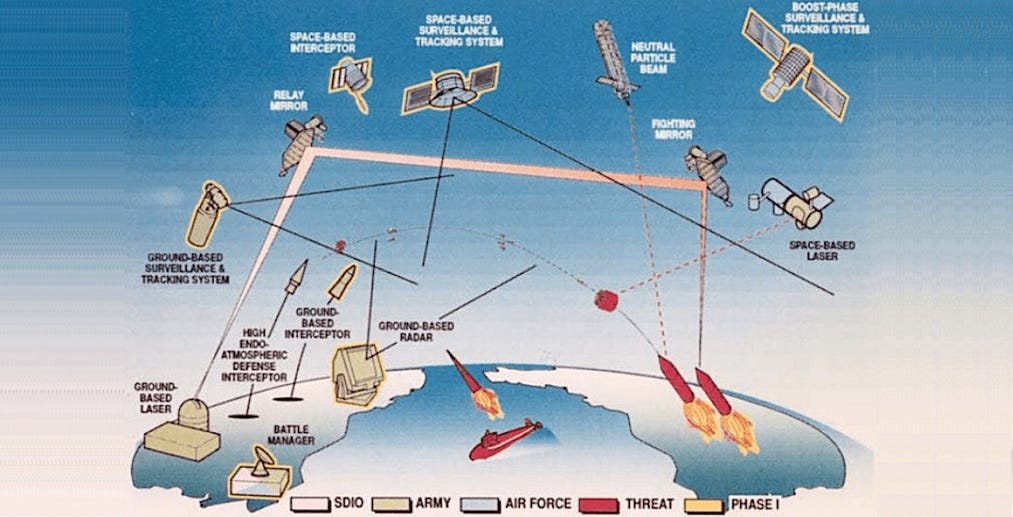
The vision involved detecting Soviet missiles and destroying them during different phases of flight using a layered defensive system (above) extending into space. Among the technologies considered were high-energy lasers, nuclear-pumped X-ray lasers, free-electron lasers, neutral particle beams and other forms of directed energy, supported by sophisticated sensors, radar and battle-management systems.
The scale was extraordinary. By the end of fiscal year 1991, SDIO[5] had received $20.9 billion for research and development, including $6.3 billion for sensors and $4.9 billion for directed-energy weapons.
But look at what those billions bought.
Beneath the individual weapons concepts lay overlapping technologies: intense electron and ion beams, high-power microwave systems, pulsed-power generators and switches, free-electron lasers, fusion-derived technologies and the extreme-energy conditions required to generate and control them. By 1991, SDIO’s pulsed-power research alone was supporting neutral particle beams, space-based free-electron lasers, ground-based lasers, electromagnetic launchers, laser radar and high-power microwaves. Plasma opening switches were being investigated on enormous machines at Sandia[6] and NRL to compress and multiply electrical power.
Many of these technologies predated Reagan. What SDI supplied was an organising mission powerful enough to draw them into the same strategic enterprise, together with the money and urgency to see how far they could be pushed.
Scientists concerned with plasma behaviour, beam propagation, extreme electromagnetic fields, laser interaction, nuclear effects, radar and space physics were contributing to different parts of an architecture intended to solve the same almost impossibly difficult problem. Their technologies did not all work as hoped, but the effort generated experiments, measurements, models and practical knowledge about physical regimes being driven towards military capability.
Judging SDI solely by whether it produced Reagan’s promised missile shield therefore misses an important part of its legacy.
SDI was also a knowledge-convergence machine.
For a decade, a remarkable concentration of American scientific talent and resources was directed towards understanding how frontier technologies might operate together. Plasma and extreme electromagnetic physics ran through a striking proportion of that work, sometimes explicitly and sometimes as enabling science beneath technologies carrying different names.
Weapons could fail and programmes could be cancelled.
The knowledge accumulated in pursuing them was harder to make disappear.
The Great Disappearance
Then the strategic world that had created SDI disappeared.
The Berlin Wall fell in 1989 and the Soviet Union dissolved two years later. In 1991 President George H.W. Bush redirected SDI towards more limited ballistic-missile threats; in 1993 the Clinton administration renamed the Strategic Defense Initiative Organization the Ballistic Missile Defense Organization.
The age of Star Wars was formally over.
The transition coincided with a sharp contraction in some of SDI’s more exotic technologies. By 1993 its directed-energy portfolio was being reassessed programme by programme. The free-electron laser transferred to the Army; funding fell dramatically. Yet contemporary reviews show the Pentagon deciding which technologies BMDO should retain, which should transfer elsewhere and what knowledge should be preserved for possible future development.
A neutral particle beam weapon (SDI concept below) could prove impractical as an orbiting missile killer while leaving valuable knowledge about accelerators, beam propagation and plasma interactions. A laser weapon could fail SDI’s requirements while advancing optics, tracking, atmospheric compensation and high-energy laser physics. Pulsed-power machines built for one mission could serve another.
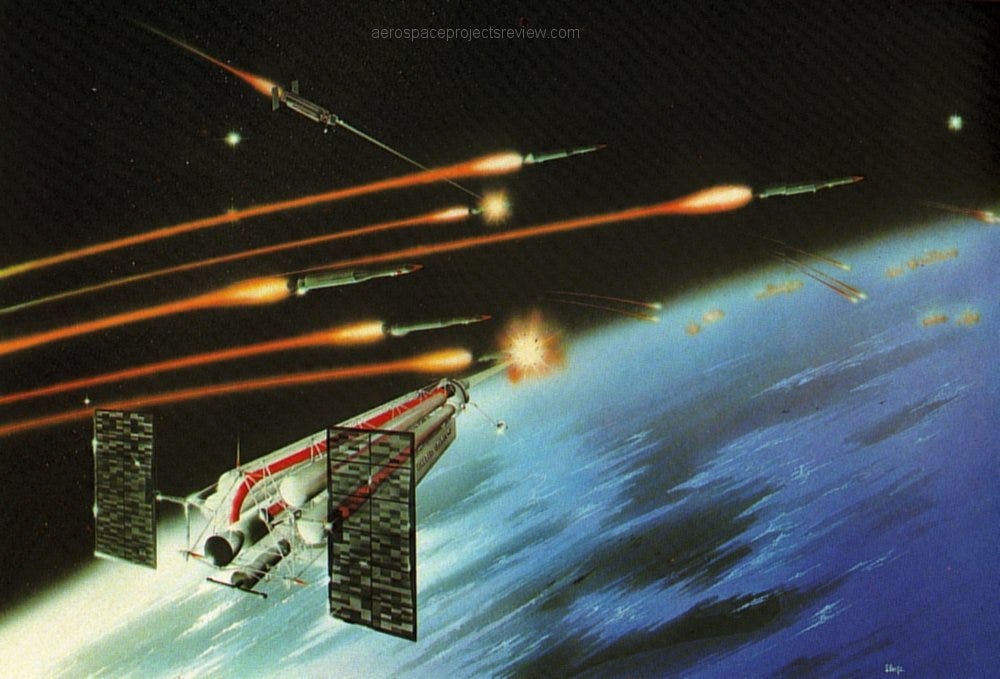
The apparent disappearance of Star Wars is therefore deceptive. When the strategic problem changed, the knowledge did not need to remain inside an organisation carrying the SDI name. It could migrate into the services, national laboratories, successor missile-defence programmes and elsewhere.
For anyone reconstructing the history later, this creates an archival illusion. A programme ends, a budget line vanishes or a technology transfers, and the trail appears to stop. The scientists, facilities, experimental results and accumulated understanding may simply have moved.
From outside: dead programme.
From within the research ecosystem: accumulated knowledge.
So, rather than looking for a secret successor to SDI, perhaps we should ask what sort of architecture could retain what it had learned.
An Ecosystem Built to Remember
The US defence research establishment is an ecosystem of government laboratories, national laboratories, research agencies, military services, contractors and federally funded research and development centers – FFRDCs. Technologies and people move between them while different institutions preserve different kinds of expertise.
NRL provides perhaps the clearest example of scientific continuity. Its history runs from radio and radar through the ionosphere and space into nuclear effects, plasma physics, intense beams, pulsed power and directed energy. A weapons programme may last five or ten years; a laboratory can retain scientists, facilities, models and accumulated knowledge across generations. The national laboratories at Los Alamos, Lawrence Livermore and Sandia perform similar long-term functions in nuclear effects, fusion, high-energy-density physics, pulsed power and related fields.
Certain FFRDCs add another form of continuity. Institutions such as the Aerospace Corporation, RAND and the Institute for Defense Analyses provide technical, analytical or systems-level support across long-running national-security problems. A laboratory may understand in extraordinary depth how a physical effect works; an FFRDC supporting a defence sponsor may be positioned to ask how mature the technology is, how it fits into a wider architecture, what other capabilities it enables and what happens when it is combined with something else.
JASON[7] adds cross-cutting scientific scrutiny, drawing leading scientists into difficult national-security problems across the boundaries of individual programmes.
Seen this way, searching for a single custodian of the knowledge accumulated under SDI looks misplaced. Laboratories could preserve physical understanding; DARPA explores applications; FFRDCs provide analytical and systems-level continuity; JASON scientific scrutiny; services and contractors turn selected effects into capabilities.
SDI temporarily forced many of those functions towards the same strategic objective. When that objective fragmented, the institutions remained.
There need never have been a hidden ‘plasma programme’ preserving a unified body of secret science. The national-security system already possessed an architecture capable of retaining knowledge while distributing it among organisations, missions and security compartments.
The memory did not have to reside in one place. It could reside in the ecosystem itself.
Strategic Fragmentation
Across this longer history, plasma became increasingly difficult to perceive as a single strategic field because its applications had spread so widely: nuclear effects, radar propagation, electronic warfare, space systems, fusion, high-energy-density physics, pulsed power, directed energy, missile defence and ionospheric research.
There is an intriguing parallel with the way the US classification system treats information. Defence doctrine allows for ‘classification by compilation’: individually unclassified pieces of information can become classified when their combination reveals a sensitive association or relationship. In the language of current DoD guidance, ‘the whole is greater than the sum of the parts’.
This does not establish that plasma science has been deliberately protected this way. It illustrates a more general point: strategically sensitive information can reside in the relationship between facts.
The physics of an ionised gas can be public. So can a paper on radar propagation, a pulsed-power experiment or ionospheric research. Greater strategic value may reside in knowing which plasma state, produced under which conditions and interacting with which electromagnetic field, creates an effect useful for sensing, disruption, deception or directed energy.
The consequential secret may therefore look less like:
A is classified.
and more like:
A + B + C = capability D.
This helps explain why the history is difficult to reconstruct from outside. Researchers follow programme names and institutional boundaries; physics is indifferent to either. An effect discovered during nuclear-weapons research may later matter to directed energy. A technique developed for missile defence may acquire another application entirely.
Over seventy years, an extraordinary amount can become publicly known while strategically important synthesis remains obscure. Classification, compartmentalisation, institutional boundaries and simple specialisation are enough to produce that result.
The branches remain in view.
What becomes difficult to reconstruct is the tree.
And this is where our history finally reconnects with the question that started the investigation.
UAP.
The Object That May Not be an Object
The idea that plasma might account for at least some UFO sightings is hardly new. More interesting here is that the possibility has surfaced inside the defence establishment itself.
