

The Participation Dialogues
Part 1: Contact in the Desert

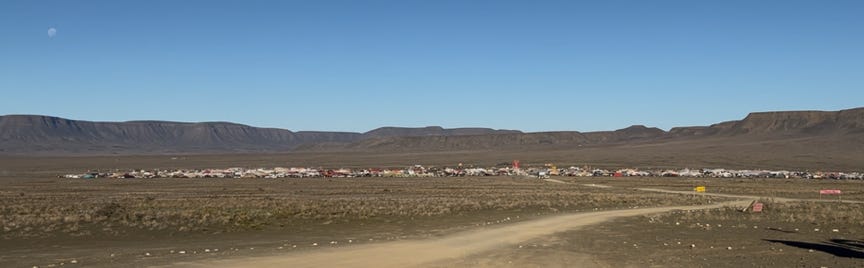
The Tankwa Karoo - a vast semi-desert basin in South Africa’s Northern Cape.
For the first time in years, I am in a place with no signal, no WiFi, no informational current demanding my attention. There’s just dust, inches deep, the beguiling vista of open desert, and – stretching into the distance – an encampment, a temporary town, designed to house 11,000 people for a little over a week.
I had come to AfrikaBurn with mixed feelings. Over the years, I’d heard enough about the more performative and, shall we say, expressive side of Burn culture to feel slightly wary of the whole thing.
Early Burning Man culture[1] - that is the culture of the US festival from which AfrikaBurn spun out – was shaped by a set of quasi-philosophical principles that emphasised radical self-expression, participation, gifting, communal effort, self-reliance and the temporary suspension of commercial culture. Beneath the spectacle sat a deeper ethos: that human beings might relate to one another – and to reality itself – differently when removed from the normal architectures of status, consumption, hierarchy and algorithmic mediation. The desert became less a festival site than a social experiment in alternative forms of attention, creativity and collective meaning-making.
Over time, however, critics and longtime participants argue that the festival has drifted away from its original ideals. What began as an anti-commercial countercultural experiment increasingly became entangled with wealth, status and Silicon Valley culture, with luxury camps, corporate networking and elite techno-utopianism gradually reshaping parts of the event’s social fabric.
For some, this evolution reflects the difficulty of sustaining genuinely alternative social systems once they become culturally influential; for others, it illustrates how quickly even experiments in radical participation can be reabsorbed by the economic and status structures they originally sought to escape.
So before leaving for South Africa, I made myself a quiet promise.
If I was going to spend the best part of a week here, I would use the experience to learn about indigenous wisdom traditions – something, due to the direction my studies had been taking me, I’d already promised myself I would do. Friends who had invited me to join them at AfrikaBurn insisted that Burning Man’s South African cousin – still steeped in its pagan guiding principles – would be able to accommodate my wish.
We’d see, I thought.
Upon arriving at the outer limits of Tankwa Town[2], Burn ‘virgins’ – first-time attendees like me – were invited to take part in a short ritual. We were encouraged by a small welcome committee, each sporting what I would soon recognise as Burn chic couture – think Mad Max meets the excess of 1980s London clubbing culture – to roll in the dust before approaching a row of chimes between two wooden posts. Each person, silently and privately, was asked to declare an intention before ringing them.
Fine desert earth pressed into my skin and my clothes beneath an enormous blue sky. Then I got up and paused briefly – carrying the thought sincerely and very consciously - before striking the chimes:
Teach me something real here.
Nothing happened, of course. There was no blinding revelation, no mystical experience, no sudden transformation.
But looking back, I suspect that moment mattered more than I realised at the time.
Because participation had already begun.
That first evening, at our encampment, I met the twenty people with whom I’d be sharing the week. Among them: artists, technologists, musicians and researchers – but also a small group of San elders, including two sisters, one in her eighties, the other in her seventies, who spoke in traditional click language. Their son and nephew – a gifted musician and storyteller – translated for them. The San are among the oldest continuous indigenous cultures on Earth, with traditions rooted in the deserts, savannahs and semi-arid regions of Southern Africa stretching back tens of thousands of years.
One of the first things someone told me that night was this:
‘If you want to get the most out of AfrikaBurn, stop trying to control the experience. Follow synchronicity. Follow flow.’
A day earlier, I very likely would have dismissed that kind of language. But something about the environment was already beginning to alter the texture of my perception.
Without the usual informational overload of ordinary life, attention began behaving differently. Over the course of that first day, conversations slowed and deepened. Time itself felt subtly less compressed. People, it seemed, stopped performing. Connections started to form. And perhaps for that reason alone, I decided – at least temporarily – to suspend disbelief.
Not belief.
Just disbelief.
The Water
The following morning, an opportunity arose to accompany our San elders to a water blessing ceremony some distance from the ‘suburbs’ of Tankwa Town. We walked for half an hour across the hard-baked floor of the Tankwa Karoo: around forty of us moving slowly through dust, silence and heat towards one of the few natural springs in the area. Along the way, participants were encouraged to pick up small stones from the desert floor. These, we were told, would later be offered to the water.
The ceremony itself was simple. We gathered around the source of the water while two shamans, Jethro and Sarah, guided the ritual. One by one, each participant was invited to say something meaningful aloud – an intention, a hope, a thought, a grief – before throwing their stone into the water.
When my turn came, I spoke and threw the stone. Almost immediately Jethro grabbed me. “Look,” he said excitedly, spinning me around and pointing at the water. “Do you see?”
Some bubbles had begun rising slowly from beneath the surface.
“The water spirits heard you,” he said.
Under normal conditions, my instinctive reaction would have been scepticism. Bubbles rise from water all the time. Gases escape. Mud shifts.
And yet what struck me was not the bubbles themselves.
It was my reaction to them.
For the first time, I found myself not immediately needing to collapse the experience into either belief or dismissal. Instead, I made a different decision.
I let go.
Not into irrationality.
Not into credulity.
But into participation.
After all, I had come to the desert partly to confront the deeply ingrained habits through which I normally organised reality. The reflexive need to stand outside normal experience. To decode everything immediately. To maintain cognitive control at all times.
And so, I decided – at least temporarily – to stop resisting the possibility that meaning might sometimes emerge through participation itself.
What followed over the next few days would make that decision feel increasingly significant.
The Fire
Two mornings later, before dawn, the camp gathered again.
My new friends had constructed a traditional grass hut near the edge of the playa earlier in the week – their contribution to the temporary city that had emerged out of the desert dust.
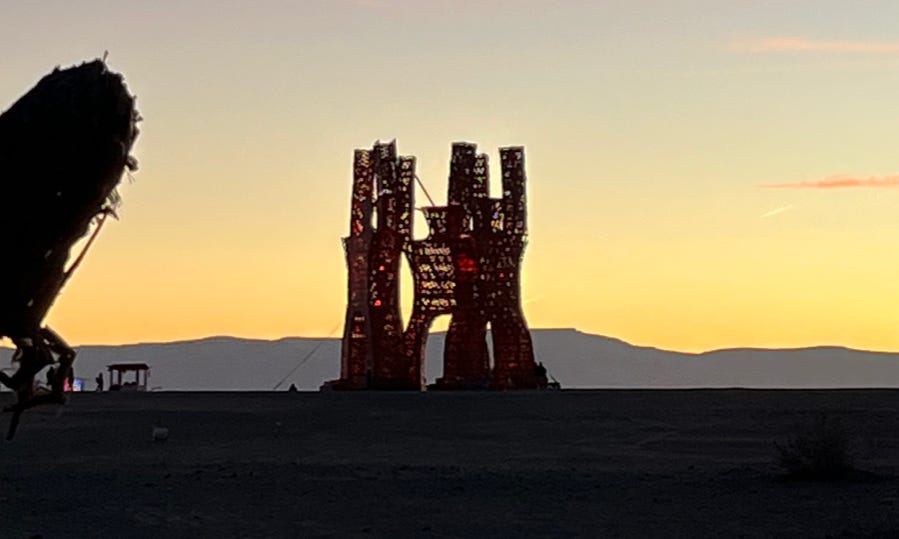
It was on the playa that the effigy of the burning man and other pieces of sculpture and artwork were on display for Burners to enjoy during the week. Throughout the Burn, our hut became a place where people gravitated almost instinctively. Musicians gathered there at night. Stories were told there. Strangers sat together in long, unplanned conversations beneath its woven walls while drums and local instruments competed across the darkness with the thump of dance music emanating from multiple other gatherings nearby.
The plan had been to burn the hut as part of the week’s rituals. But strong winds arrived on the morning scheduled for the burn, making it too dangerous to light.
So instead, before sunrise, the camp gathered quietly around a smaller ceremonial fire nearby while the two elders – our ‘ohmas’ – danced in the half-light.
As sparks lifted into the cold desert air, their son and nephew, Petrus, began telling stories about animals, tricksters, spirits, landscape and transformation. Stories in which the boundary between psyche, nature and cosmos did not appear especially rigid.
In the contemporary world, reality is generally treated as something external: objective and measurable, fundamentally separate from us. Meaning is something human beings project onto an otherwise indifferent universe. But inside many older traditions, participation comes first. The world is not experienced as dead matter observed from outside.
It is experienced as relationship.
Landscape, symbol, story, ritual, emotion, dream and community all exist inside a continuous field of meaning rather than in separate categories artificially divided from one another. And sitting there beside the fire, watching sparks disappear into the pre-dawn sky, I began to understand something that will become central to this series:
modernity may have generated extraordinary technological power partly by separating ourselves from participation. By standing outside the system. By converting reality into object.
And yet something fundamental seems to have been lost in the process. Not because indigenous cultures possess magical answers modern science lacks. Romanticising them would be both naïve and patronising. But because they may have preserved forms of attentional relationship to reality that industrial civilisation systematically trained out of itself.
The more time I spent in the desert, the more I began noticing that participation was not simply a philosophical idea.
It altered perception itself.
As attention slowed and conversations deepened, coincidence became more noticeable and the environment felt strangely responsive.
Not supernatural or irrational. Just less psychologically filtered than it did in ordinary life.
And increasingly, I found myself wondering – not for the first time[3] – whether what we call ‘normal reality’ might actually be a highly managed attentional state – one optimised for productivity, control and social performance rather than presence.
The Lights
The sighting happened two nights later.
By then, something in my relationship to the environment had already changed. Not my critical faculties or my scepticism. Those remained intact. But the internal posture through which I normally encountered reality had become subtly less defended, less compulsively analytical.
Most of our camp was gathered together – we had just finished eating dinner – when the first light appeared low on the southern horizon.
At first, it looked unremarkable. Bright white, stationary for a moment against the darkness. Then it began moving – not in the smooth linear path of an aircraft or a satellite, but in short, strange manoeuvres that immediately caught our attention. Then it dimmed, disappeared and reappeared somewhere else.
A second light emerged nearby. Then another. At one point there may have been five visible simultaneously, interacting across the same section of sky for close to forty minutes while a group of us watched in near silence.
Importantly, I want to be extremely careful here.
I have seen unusual aerial phenomena before. Most memorably on the periphery of Area 51 more than thirty years ago – experiences I later wrote about in The Light Beyond the Mountains. But in every previous case I eventually arrived at a plausible rational explanation. I was trained professionally to understand what moves through our skies – both openly and secretly[4].
This felt different.
Not necessarily because it was different in any objective sense. But because, for the first time, I found myself unable to arrive at a stable explanatory frame that fully satisfied me.
And strangely, that no longer bothered me as much as it once would have.
Because what began interesting me was no longer simply the phenomenon itself. It was the context in which the phenomenon appeared.
The desert.
The disconnection from ordinary informational life.
The altered attentional state.
The rituals.
The social coherence.
The surrender to synchronicity and flow.
The gradual suspension of hyper-mediated cognition (in which our perception, attention and interpretation of reality are continuously filtered, shaped and pre-structured by technological, informational and social systems before we directly experience the world ourselves).
In other words: participation.
And this, I slowly realised afterward, may point towards one of the central mistakes modernity makes when confronting anomalous experience.
We isolate the anomaly from the field in which it emerges.
We focus obsessively on the object – the light, the craft, the event, the data point – while ignoring the surrounding human conditions under which perception itself changes.
But what if the conditions matter?
What if participation is not incidental to anomalous experience, but part of the mechanism through which such experiences become available in the first place?
I am not claiming the lights were extraterrestrial craft. Nor am I claiming they were supernatural. I am making a narrower – but perhaps more important – observation: that the experience forced me to confront the possibility that consciousness, attention, environment, expectation, symbolism, coherence and perception may interact more deeply than our current models comfortably allow.
And once that possibility enters the frame, the question changes completely.
The issue is no longer simply: ‘What did we see?’
It becomes: ‘What kind of reality produces experiences like this under conditions like these?’
The Realisation
I did not leave AfrikaBurn believing I had discovered hidden truths about the universe. What changed instead was something subtler: my relationship to certainty itself.
The culmination of my last Substack project - The Outlier Series – was AIM, the Adaptive Interface Model, a tentative framework for thinking about reality not as a fixed mechanical system, but as an adaptive informational process in which consciousness participates.
Drawing together ideas from quantum mechanics, systems theory, neuroscience and anomaly research, AIM proposes that certain phenomena – synchronicities, UAP encounters, psi experiences and states of heightened coherence – may function as feedback signals arising within a participatory universe under conditions of stress, transition or transformation.
