

The Resilience Question
A Thoughtful New Framework for Disclosure, Resilience and Societal Adaptation

How do individuals and societies remain coherent when their model of reality changes faster than their ability to adapt?
That question has sat quietly beneath much of my recent work.
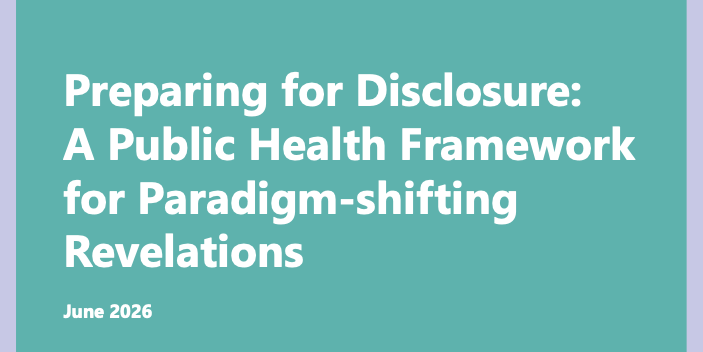
It sits beneath The Outlier Series. It sits beneath the Adaptive Interface Model (AIM). And, intentionally or not, it also sits at the heart of a new paper released today from John Priestland and the team at uNHIdden titled Preparing for Disclosure: A Public Health Framework for Paradigm-Shifting Revelations.
At first glance, the paper appears to belong to the growing body of literature around UAPs, non-human intelligence, and the possibility of disclosure. Yet that is not really what it is about.
In fact, one of the most interesting things about the report is that it largely sidesteps the question that dominates most disclosure discussions: Is it true?
Instead, it asks a different question.
What happens if a revelation occurs that fundamentally challenges humanity’s understanding of itself and its place in the universe? More specifically, what happens if such a revelation arrives before individuals, institutions, and societies have developed the psychological resources to absorb it?
This is where the paper becomes interesting.
The authors approach the issue not as intelligence analysts, theologians, or futurists, but through the lens of public health. Their argument is straightforward. Public health systems routinely prepare for low-probability, high-impact events. Governments plan for pandemics, natural disasters, and infrastructure failures long before they occur. Why should a paradigm-shifting revelation be treated differently?
Whether one believes disclosure is imminent, unlikely, or impossible is almost beside the point. The report argues that if the consequences of such an event could be profound, then preparedness deserves consideration regardless of one’s position on the underlying phenomenon.
The paper introduces the concept of ‘ontological shock’ to describe the psychological disorientation that can occur when a person’s fundamental assumptions about reality are disrupted. It is not presented as a formal clinical diagnosis but rather as a useful description of a category of human response.
The idea itself is hardly new. History is punctuated by moments when established models of reality gave way to something larger. The Copernican revolution displaced humanity from the centre of creation. Darwin challenged prevailing assumptions about human uniqueness. Relativity and quantum mechanics altered our understanding of space, time, and causality. Each required a painful period of adaptation.
Yet the pace of change today appears different.
Artificial intelligence is forcing questions about cognition and creativity. Neuroscience continues to erode traditional boundaries between mind and matter. UAP investigations are moving from the fringes of public discourse into formal governmental and scientific institutions. Long-standing assumptions across multiple domains are beginning to wobble simultaneously.
From an AIM perspective, this observation is particularly interesting.
The Adaptive Interface Model, which represented the culmination of The Outlier Series, proposes that reality functions less like a fixed environment and more like an adaptive informational system. In such a framework, coherence matters. Individuals, communities, and institutions rely upon coherent models of reality in order to function effectively.
When those models are disrupted too rapidly, stress accumulates. Meaning structures fracture. Anxiety increases. Polarisation follows.
Sounds familiar?
The question then becomes not whether disruption occurs, but whether sufficient coherence can be maintained during the transition.
Seen through this lens, UNHIdden’s report can be read as an attempt to build what its authors call ‘ontological resilience’ – the capacity to remain psychologically stable while accommodating profound changes in understanding.
That may ultimately be the report’s most valuable contribution.
Its strongest sections are not those dealing with disclosure itself. They are the sections concerned with resilience, trust, communication, and adaptation under uncertainty. The paper recognises something many institutions struggle to acknowledge: information alone does not create understanding. Human beings require narratives, communities, frameworks, and time in order to integrate disruptive knowledge.
Not everything in the report will convince every reader. Some of its quantitative estimates are necessarily speculative because there has never been a disclosure event against which they can be measured. Likewise, the concept of ontological shock remains more a useful framework than a settled scientific category.
Yet those limitations do not undermine the central insight.
The report asks a question that reaches far beyond UAPs.
How should societies prepare for realities that challenge their deepest assumptions?
In many ways, that may be the defining question of our age.
The challenge is no longer simply acquiring information. We live in an era of information abundance. The challenge is integrating information without fragmenting psychologically, socially, or institutionally.
Whether the catalyst is artificial intelligence, biotechnology, consciousness research, climate disruption, or some future disclosure event, the underlying problem – as my colleagues and I made clear at the recent launch of our EXO Institute – remains remarkably similar.
How do we remain coherent when reality appears to be changing faster than our capacity to adapt?
That, ultimately, is why this paper deserves attention. Not because it proves anything about non-human intelligence. Not because it settles the disclosure debate.
But because it begins exploring what may prove to be one of the most important public health questions of the twenty-first century.
Perhaps the future will belong not to those who possess the most information, but to those who develop the greatest capacity to integrate it.
Time, Times & Timing…
Rhythms, Ratios & Rituals of Integration
Disclosure Days
Confirmation Nights
Metanoia Mornings