

UAPs, Buybacks And Stewardship
The Crisis Inside the Defence State

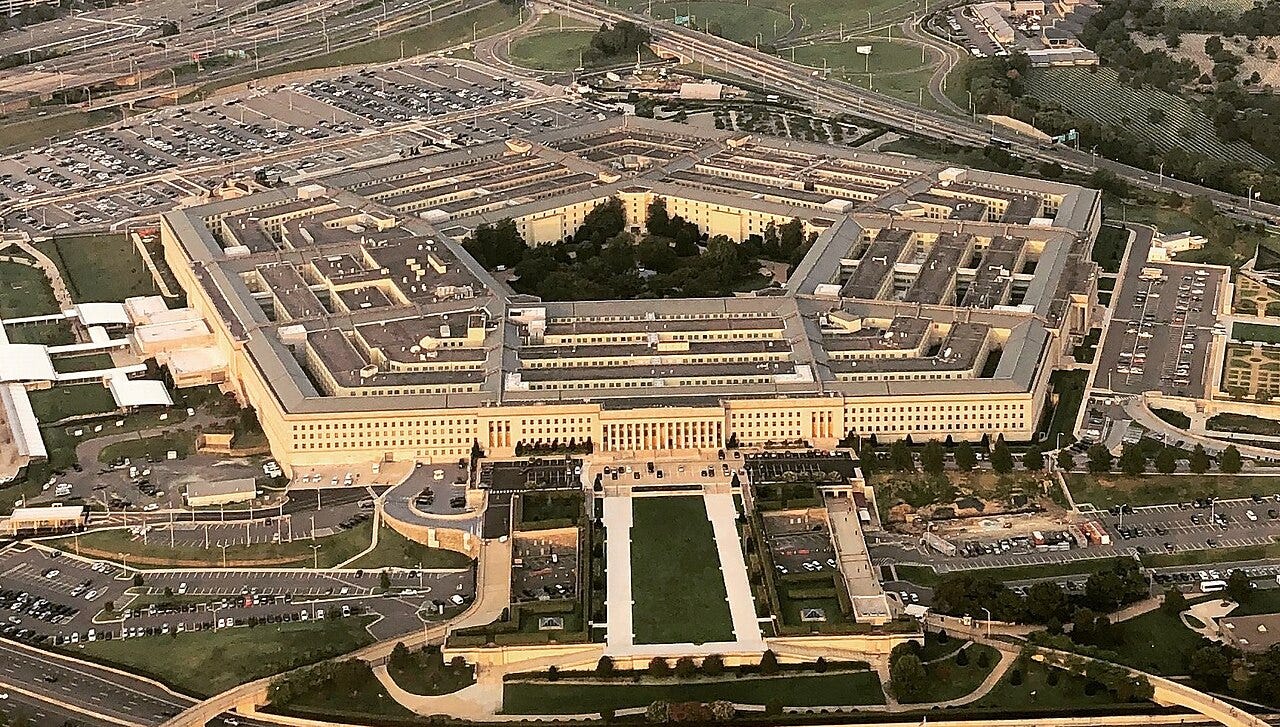
There is a tendency in some circles to frame the Western defence ecosystem as ‘broken’. Despite visible strains – fractures within NATO over defence spending commitments, growing disagreement over the terms and timing of any Ukraine settlement, and more recent tensions between Europe and the United States over Greenland and Arctic sovereignty – that framing is both inaccurate and strategically unhelpful. The system still functions. Deterrence still holds … for now. Budgets continue to rise.
What has changed is something subtler – and more consequential. And, counter-intuitively, we can partly thank the growing political focus on unidentified anomalous phenomena (UAPs) for helping to bring it into view. I’ll explain why shortly.
Over the past week, the US defence and aerospace sector has been placed under an unusually harsh spotlight by Donald Trump, following his proposal for a roughly 50 per cent increase in national defence spending – to an eye-watering $1.5 trillion annually. Alongside that proposed expansion, Trump has accused parts of the defence industry of prioritising shareholder returns and executive compensation over production capacity, delivery performance, and readiness – an accusation formalised in an executive order targeting stock buybacks and incentive structures. Whether one agrees with the diagnosis or not, the signal is unmistakable: more money will come with sharper political scrutiny and higher expectations of demonstrable output.
This could scarcely come at a more pivotal moment. Geopolitical tension is intensifying. Despite intermittent efforts to broker a settlement, the war in Ukraine grinds on. Strategic competition with China continues to accelerate. Russia, meanwhile, has leaned heavily into grey-zone tactics – cyber operations, information warfare, coercive energy policy – that strain traditional Western planning assumptions.
At the same time, and underscored by lessons from Ukraine and by NATO’s own increasingly blunt assessments of readiness, anxiety is growing about industrial capacity itself: production throughput, surge resilience, supply-chain fragility, and the West’s ability to sustain prolonged, high-intensity conflict at scale.
Overlaying all of this is the renewed concern – expressed in Trump’s characteristically unvarnished style — that the defence sector has become excessively financialised. Stock buybacks, executive remuneration, and shareholder primacy have moved from background features of corporate governance to front-page political issues. Trump’s executive order framed these practices as potentially misaligned with warfighter readiness, reigniting a long-simmering debate about whether a sector funded overwhelmingly by taxpayers should behave like any other publicly listed industry.
At the same time, new entrants with Silicon Valley roots – companies such as Palantir – are challenging legacy primes not just technologically, but culturally. They privilege software, speed, iteration, and tight alignment with operational users over scale, process, and cost-plus stability. Artificial intelligence compounds this disruption, increasing system opacity rather than reducing it, and shifting critical knowledge from human-legible processes into models that are harder to audit, explain, or govern.
Now to the initially counter-intuitive UAP component in all this.
Congress’s growing unease about fiscal traceability and accountability, aired during recent UAP hearings, may not have resolved questions about the existence of non-human technology, or the reality of alleged crash-retrieval programmes. But those hearings did something arguably just as important. They surfaced, in public, unresolved questions about who owns certain classes of data, who has authority to adjudicate conflicting sensor records – that is, when radar, infrared, satellite, and pilot reports disagree, who has the final authority to decide which data is trusted – and who can compel disclosure across deeply classified, contractor-dominated systems.
What matters is not any single strand of this argument, but the fact that they all point to the same underlying weakness.
The core problem is not secrecy. It is stewardship – and, increasingly, trust.
Modern defence systems now exhibit a responsibility gap created by ever-greater distributed complexity. In broad, typical terms – and with important exceptions – the system often looks like this:
Contractors own much of the critical intellectual property
Government owns the mission and strategic intent
Operators own the operational and personal risk
Oversight bodies lack continuous access to technical detail
In other words: everyone touches parts of the system, but no one governs it end-to-end.
This configuration is not necessarily the result of bad actors or hidden agendas – although such dynamics unquestionably exist at the margins. More fundamentally, it is the predictable outcome of decades of outsourcing technical knowledge, accelerating system complexity, deepening classification, and incentive structures that reward short-term financial or schedule performance over long-term system clarity – in other words, systems that deliver but are increasingly difficult to fully understand, explain, or audit.
Under these conditions, accountability diffuses; the flow of money through the system – including highly classified or ‘black’ funding – becomes harder to trace; ownership fragments; and reform becomes structurally difficult, even when participants are acting in good faith.
This is why the UAP issue matters structurally as well as sensationally.
The significance of those hearings was not merely that they gestured towards extraordinary secrets or technologies, but that they revealed governance strain under adversarial questioning. Members of Congress encountered a system in which basic questions – where data resides, which sensor is authoritative, who can declassify context, and which office has adjudication authority – produced multiple answers that did not converge. That is not simply a mystery problem. It is a governance alarm bell.
UAPs did not create this condition. But they exposed it in a way that routine acquisition debates rarely do.
The question, then – especially in the context of this week’s developments around defence-sector governance and the proposed hike in US defence spending – is whether the defence ecosystem is fit for purpose in a world defined by software-driven capability, AI opacity, contractor-owned knowledge, and accelerating geopolitical competition. The system was optimised for a slower, hardware-dominant, hierarchically governed era. It now operates at a level of speed and complexity that its stewardship mechanisms have not fully caught up with.
To understand why, it is worth looking back.
The last truly systemic overhaul of the US defence industrial base occurred in the early 1990s, centred on what became known as the ‘Last Supper’.
In July 1993, in the context of the post-Cold War drawdown, then-Deputy Secretary of Defense William Perry invited the CEOs of the major US defence contractors to a private dinner at the Pentagon. The intent was explicit: to force consolidation in order to preserve core capabilities under sharply shrinking budgets.
The message was blunt. With the collapse of the Soviet Union, defence budgets were going to fall sharply. The United States no longer needed Cold War-scale industrial capacity. And the government would not bail out firms that failed to adapt.
Perry told them, in essence: there are too many of you. Consolidate – or the market will do it for you.
And it did.
The results were dramatic. Roughly fifty major defence primes collapsed into five or six in short order. Massive mergers created today’s giants: Lockheed with Martin, Northrop with Grumman, Boeing with McDonnell Douglas, and Raytheon’s later consolidation path.
This reshaped the defence industrial base for a generation. But it also locked in characteristics that now sit at the heart of today’s unease: enormous primes with limited competition; deep reliance on cost-plus contracting; heavy political and regional entanglement; and increasing distance between government oversight and technical detail.
At the time, this was widely seen as a success. Capability was preserved. Jobs were stabilised. Budgets were controlled.
But here is the crucial point.
The ‘Last Supper’ optimised the defence industrial base for a post-Cold War, hardware-centric, platform-driven world. It did not anticipate software-defined warfare, AI as a core military capability, contractor-owned digital IP as mission-critical infrastructure, long-duration great-power competition, or a return to sustained, industrial-scale conflict. Nor did it address stewardship at the knowledge level – who actually knows what, who decides which knowledge counts, and how truth is adjudicated once systems become too complex or classified for any single actor to fully grasp.
Since 1993, the system has grown more technologically complex, more financially sophisticated, more classified, and more contractor-dependent – without a corresponding reset of governance assumptions.
No equivalent overhaul has occurred since. Consolidation has largely run its course, with the same primes dominating. Post-9/11 urgency favoured speed over structure, yet programme overruns and schedule slippage remain commonplace. Software, data, and AI blurred industrial boundaries. And no Secretary of Defense since Perry has been willing to provoke the top tier of the sector at anything like the same scale. The result has been incremental fixes – and, arguably, innovation stagnation, at least on an unclassified level - layered onto a thirty-year-old structural settlement.
Seen through this historical lens, a number of recent developments suddenly make sense. A new era of reform begins to look expedient – not for the economic reasons of the 1990s, but for a different imperative: restored trust at a moment of extreme geopolitical tension, and a renewed demand for accountability from government all the way down to the taxpaying public in this most consequential of sectors.
In that present light, buybacks look politically toxic. Independent Research and Development (IRAD) – company-funded R&D intended to anticipate future government needs and later recovered through overheads – attracts renewed scrutiny, not least because its opacity can blur the line between legitimate innovation, speculative investment, and deeply classified work with limited external visibility. Eminent-domain language has re-entered the conversation as lawmakers confront the possibility that critical materials, data, or technologies funded by the state may reside beyond clear government control – a concern sharpened by the UAP debate, where questions of ownership and authority have repeatedly surfaced. New defence entrants gain traction. Congressional pressure intensifies. Trust – not funding – becomes the limiting factor.
This does not mean the defence system is broken. It means it is facing a stewardship crisis at precisely the moment when coherent stewardship matters most.
Reform efforts, including recent executive actions, can be understood as attempts – reactive, partial, and politically constrained – to reassert control over a system whose knowledge, authority, and accountability have drifted out of alignment. UAP hearings become symptoms of a breakdown in shared understanding and authoritative knowledge, as much as vehicles for disclosure. And the rise of new defence firms reflects not just technological innovation, but a search for governance models better suited to contemporary complexity.
That is the story worth telling: not one of collapse, but of a system struggling to govern what it has built and is responsible for – and to ensure it is fit for purpose in an era that may yet be shaped by UAP disclosure and the technological, institutional, and knowledge-level consequences that would inevitably follow.
If history is any guide, defence-industry CEOs may want to watch their calendars closely. The last time pressure began to build toward this point, it ended with an exclusive dinner at the Pentagon — and a very blunt conversation about who would still be standing when the plates were cleared.
The term "stewardship", for me, invokes the notion of time and its progression. The "West" tends to plan and stratrgise on truncated timescales...culturally, we lack the lived concept of "legacy", forgiving the side-on pun.
Great historical context...