

Déjà Vu
Reality’s Reveal on the Island of Dreams

This story begins on a small island in the Mediterranean.
For most people, Ibiza evokes images of beach clubs, electronic music and all-night parties. Yet beneath that surface lies another culture, one that has long attracted seekers, artists and experimenters drawn by the island’s reputation as a place of spiritual exploration. This confluence of currents has led to its informal name as ‘the island of dreams’.
It is perhaps no surprise, then, that Ibiza has become home to the Tyringham Initiative, founded in 2015 by Anton Bilton and Rory Spowers, whom I’ve known for several years. The initiative brings together scientists, philosophers, physicians, psychonauts, indigenous practitioners and consciousness researchers to explore questions that sit beyond the boundaries of conventional academic inquiry. This year’s gathering, held at Juntos Farm in the centre of the island, carried a provocative title: ‘Entities: The Good, the Bad and the Ugly.’
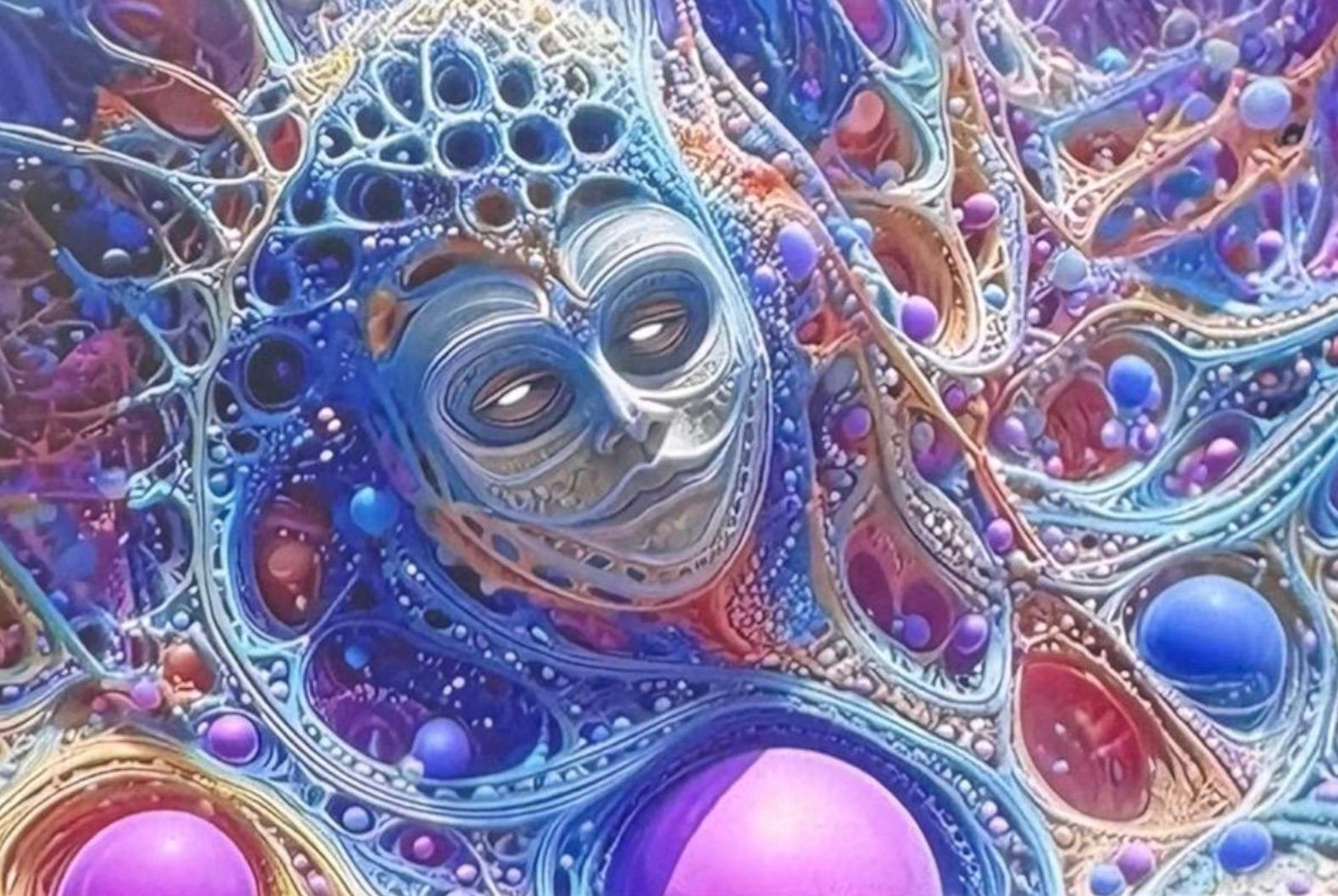
The event opened with the premiere screening of a documentary (a still from its extraordinary suite of graphics is shown above), Entities – A Scientific Exploration Through Psychedelics, Spirituality and Ancient Wisdom, which follows Anton on a seven-year journey through indigenous traditions, modern science and the phenomenon of entity encounters.
Readers of my last column will know that ancient wisdom traditions have become an increasing area of interest for me. One of the unexpected lessons of recent years has been discovering how many ideas that appear radical or novel in contemporary consciousness research have existed for centuries within indigenous cultures and contemplative traditions.
This is not new territory for Anton. A profound mystical experience in his teens, followed by many years of psychedelic exploration, convinced him that encounters with what he calls the ‘Sentient Other’ are worthy of serious investigation. That conviction helped inspire the creation of the Tyringham Initiative and its support for some of the pioneering DMT research now being conducted at key universities in London.
All of which helps explain why the audience gathered in Ibiza was discussing topics rarely heard at conventional scientific conferences: angels, demons, aliens, DMT entities, mystical encounters, near-death experiences, alien abductions, and the increasingly blurred boundary between them.
The central question posed by Anton in his opening remarks was simple, timely and unsettling.
‘Are aliens the entities?’
He pointed to a curious overlap. One person’s alien is another person’s angel. One person’s demon another person’s gatekeeper[1]. One person’s fairy another’s spirit guide. Across cultures, centuries and belief systems, apparently autonomous intelligences continue to appear in human experience, often displaying strikingly similar characteristics while wearing very different masks.
Perhaps, Anton suggested, we have never been alone. Perhaps these intelligences have always been here. Perhaps they have always been part of the story.
It was a fascinating question, and one that sits at the heart of both the conference and the film[2].
Yet as I listened the following morning to the first presentation of the symposium, delivered by Dr Christopher Timmermann, Co-Director of the UCL Centre for Consciousness Research and former head of the DMT Research Group at Imperial College London’s Centre for Psychedelic Research, another question began quietly emerging beneath it.
One that reached beyond entities and deep into the nature of reality itself.
The Scientist in the Room
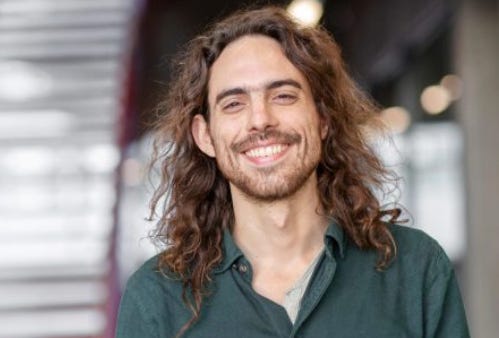
Chris Timmermann is a neuroscientist whose work over the past decade has helped establish some of the world’s leading programmes investigating DMT, altered states and consciousness[3].
His presentation focused on a deceptively simple question: What happens when the ordinary structures through which we experience reality begin to dissolve?
Participants given DMT frequently report radical alterations in their experience of self, space, time and meaning. Some describe immersive alternate realities. Others report encounters with apparently autonomous entities. Many experience profound forms of ego dissolution in which the normal boundaries of identity temporarily disappear.
None of this was particularly new to the audience. Such accounts have circulated within psychedelic culture for decades.
What was different was the context. These observations were not emerging from folklore or anecdote. They were emerging from a laboratory.
Using neuroimaging, EEG measurements and detailed phenomenological reporting, Chris and his colleagues have begun mapping the relationship between subjective experience and measurable changes in brain activity.
His aim was not to prove the existence of entities, nor to reduce them to brain chemistry. Instead, he was exploring how consciousness reorganises itself when its normal structures loosen.
And it was one particular finding that captured my attention.
The Slide
At one point, Chris displayed a slide showing a relationship between what he called entropy and entity encounters.
Entropy, in this context, refers to the degree of disorder or unpredictability within a system.
Most people would assume that if entities emerge during psychedelic experiences, they would appear at moments of maximum chaos, when consciousness is at its most fragmented and disorganised.
Yet the data suggested something rather different.
When a rapid dose (or ‘bolus’) of DMT enters the brain, the ordinary structures through which experience is organised appear to loosen. Patterns of brain activity become less constrained and more unpredictable, producing a temporary increase in entropy. In simple terms, the system becomes more fluid, less ordered and less bound by its habitual ways of constructing reality.
The entities described by subjects under test in Imperial’s lab did not appear associated with peak entropy. Instead, they appeared linked to the reconstructive phase that followed it, when a new coherence was beginning to emerge.
In other words, entities seemed associated not with maximum disorder but with reconstruction.
The finding was intriguing in its own right. But it was the next slide that stopped me in my tracks.
It was titled ‘The Dance Between Emptiness and Substance’ and depicted a progression through a series of states.
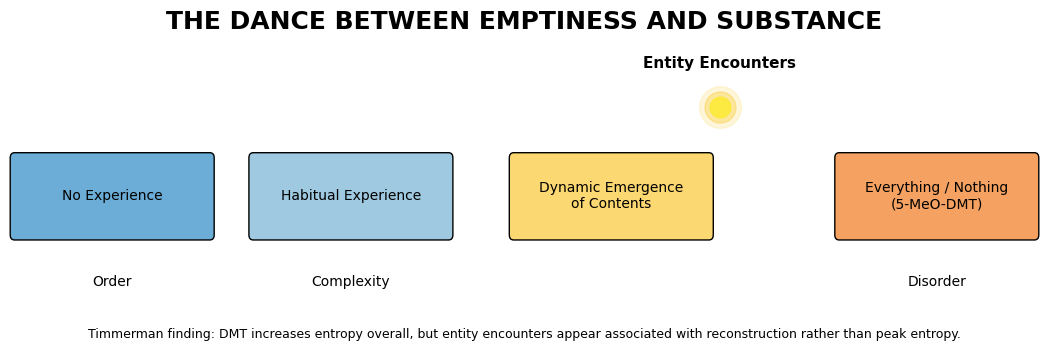
The sequence (adapted above from Chris’s slide) began with ‘No Experience’, moving into what Chris called ‘Habitual Experience’, the ordinary state through which most of us navigate everyday reality, into a period of increasing entropy. Familiar structures loosened. Certainty diminished. The normal organisation of experience began to dissolve.
Then came the critical phase. Not collapse or chaos, but what Chris described as the ‘Dynamic Emergence of Contents’. Novel forms appeared. New meanings emerged. Fresh patterns began organising themselves out of uncertainty. Eventually the system settled into a new coherence.
At the far end of the sequence, Chris placed a state associated with 5-MeO-DMT that he labelled ‘Everything / Nothing’. Participants often describe it as a condition in which the usual boundaries between self and world dissolve altogether, producing an experience of radical unity, in which emptiness and fullness appear simultaneously present. Rather than encountering novel contents, the distinction between subject and object itself appears to fade.
I had seen this pattern before.
Introducing AIM
For more than a year now, I have been developing what I call the ‘Adaptive Interface Model’ - AIM.
At its core lies a simple proposition. Reality may not be fixed and finished, as Newtonian mechanics would have us believe, but continuously adapting through interaction, feedback and participation.
In such systems, periods of rising entropy often precede the emergence of new forms. The pattern appears repeatedly across geopolitics, nature, social systems and human experience.
Between social stability and a new political order, for example, often lies a period of upheaval, uncertainty and revolution. Between life and death, some people report near-death experiences that fundamentally reorganise their understanding of reality.
The same pattern appears around many of the anomalies explored in my 12-part examination of consciousness, reality and the UAP conundrum, The Outlier Series.
Unidentified anomalous phenomena (UAP) are frequently reported around military facilities, military flashpoints and other locations characterised by unusually high concentrations of physical, informational or social stress.
Whether those correlations prove meaningful remains an open question. What matters here is the recurring association between instability and emergence and its corollary suggestion: periods of rising entropy, whether physical, social or informational, appear to create conditions in which novel forms emerge.
This was not a new idea to me. What was new was seeing a remarkably similar pattern emerging from an entirely different direction.
Chris was studying inner experience. AIM had largely been concerned with outer anomalies - phenomena that can manifest in physical reality. Yet both appeared to be describing the same underlying sequence: Disruption. Emergence. Reorganisation.
Or, in the language AIM has gradually evolved towards:
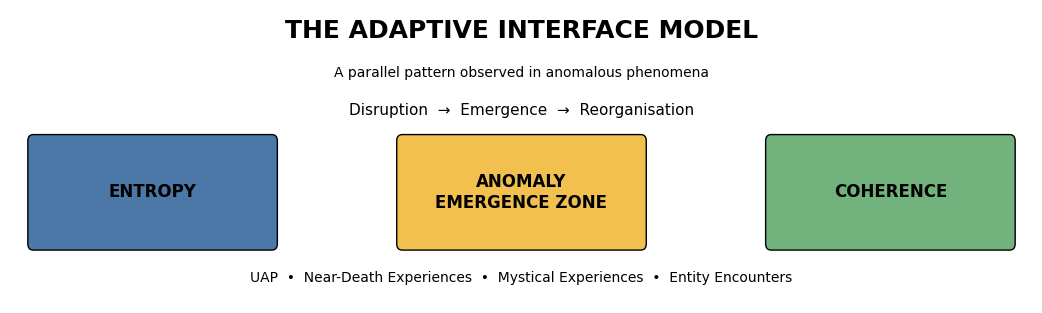
To make this more profoundly illustrative, there is a sizeable database of UAP sightings around nuclear sites. At the point of appearance, these sites are in a pivotal state between coherence (peace, order) and entropy (chaos, annihilation).
Rather than immediately assume these are extraterrestrial craft reconnoitring our most sensitive and destructive weapons, AIM posits the idea - nothing more at this point - that the appearance of UFOs in these places may reflect a response of the underlying substrate of the universe itself to rising entropy at particular nodes within the system.
Chris’s slide was not evidence that DMT entities and UAP (or the non-human intelligences [NHIs] appearing in encounter accounts alongside UFOs) are the same phenomenon. Nor was it evidence that psychedelic experiences reveal hidden truths about the universe. But it did suggest the same pattern appeared to be operating across domains that had traditionally been treated as separate: inner and outer.
For years I have suspected that the outer/inner distinction might be less rigid than we assume. Donald Hoffman’s Interface Theory points in precisely this direction, suggesting that what we perceive as reality is not reality itself, but a user interface shaped by evolution.[4]
For AIM, Hoffman’s interface acts as a bridge between consciousness and a deeper informational reality. What we experience as the physical world may be less a direct encounter with reality itself than a simplified rendering of underlying processes too complex to perceive directly.
What Chris’s work appeared to provide was something I had not seen before: a laboratory-derived pattern that echoed dynamics I had previously encountered in studies of anomalies, consciousness and complex adaptive systems in the ‘outer realm’.
UAP are a perfect case study here, as sightings and encounters can no longer be considered entirely subjective - they often appear to multiple witnesses, as well as on advanced sensors such as radars and infra-red search and track systems. Since 2021, official reports have been released into the public domain attesting to this.[5]
The implications of Chris’s findings now seemed too significant to overlook – because they suggested a bridge between worlds that are rarely considered together: outer and inner.
The Pattern
The more I reflected on Chris’s findings, the more difficult it became to ignore the pattern. Not because entities conclusively appeared under DMT. That, after all, remains open to multiple interpretations.
What interested me was the appearance of the entity in the sequence - and the sequence itself.
Disruption.
Emergence.
Reorganisation.
Versions of this pattern appear across a surprisingly wide range of human experience.
Near-death experiences often begin with a profound disruption to ordinary reality before giving rise to a radically altered understanding of life and meaning.
Trauma, too, often involves the collapse of an existing worldview before a new sense of self and meaning can be reconstructed.
Scientific revolutions emerge when established paradigms encounter anomalies they can no longer explain, forcing the creation of new frameworks.
Even UAP encounters can appear less significant for what is seen than for their effect on the experiencer, disrupting assumptions and compelling a reassessment of what is considered possible.
In each case, the anomaly acts as a catalyst. It interrupts. It destabilises. It creates conditions in which something new can emerge. After NDEs, for example, experiencers frequently lose their fear of death. Others emerge with a lasting shift in worldview and a renewed curiosity about consciousness, reality and the deeper nature of existence itself.
This still does not prove that these phenomena - inner and outer - are related.
It does suggest that they may participate in a similar process - a possibility that leads naturally to a deeper question. Not simply what anomalies are. But whether they perform a role.
Do Anomalies Have a Function?
At first glance, the idea sounds absurd. Modern culture tends to view anomalies as errors, exceptions, problems to be solved.
Yet many adaptive systems generate signals when conditions change.
Pain alerts an organism to injury. Inflammation draws attention to infection. Market signals reveal shifts in supply and demand. In each case, the signal is not the problem itself. Its function is to draw attention to the problem.
Viewed from this perspective, anomalies – the anomalies we are interested in here: angels, demons, aliens, DMT entities, mystical encounters, near-death experiences, alien abductions and the like – begin to look different.
Perhaps their significance lies not solely in their nature, but in their effect.
Again and again, anomalous experiences appear capable of disrupting assumptions and reorganising understanding. They challenge existing models and force engagement with information that previously sat outside them.
Chris’s data offered an intriguing illustration of this possibility. The entities did not appear at maximum disorder. They emerged as a new coherence was beginning to form.
Whether those entities possess an independent, autonomous existence (it is worth stating that many psychonauts insist they do) – or, indeed, have a hand in this emergent coherence – is, in one sense, a separate question.
What mattered to me was the possibility that they were associated with a process of adaptation. A process that moves from disruption towards a new organisation of experience.
Which raises another question.
If anomalies perform a function, then what kind of reality would require such functions in the first place?
One of the reasons Chris’s work feels important is that it emerges from a laboratory rather than a monastery, a mystery school or a spiritual tradition.
For centuries, experiences of ego dissolution, mystical union and encounters with apparently autonomous intelligences have largely been confined to the domains of religion and personal testimony.
Chris’s research (and that of his colleagues) does not prove any particular metaphysical claim. What it does suggest is that some of these experiences exhibit identifiable patterns – correlations between inner experiences and EEG data – that can be studied empirically.
That alone hints that the boundary between subjective and objective inquiry may be more permeable than we have traditionally assumed – a possibility entertained by many indigenous and contemplative traditions: that the distinction between inner and outer may be less fundamental than it appears.
Dynamic Emergence
One phrase from Chris’s presentation (and clearly visible in his ‘Dance’ slide) deserves particular attention: ‘The Dynamic Emergence of Contents.’
Positioned between ordinary experience and a new coherence, it described the territory in which novel forms emerge – the unstable zone where old structures loosen and new possibilities become available.
Although developed in the context of psychedelic research, the concept invites a broader question: might similar dynamics operate beyond individual consciousness?
Many of the defining characteristics of contemporary life suggest a period of unusual instability. Artificial intelligence is reshaping assumptions about intelligence and work. Information systems are fragmenting. Political institutions are struggling to maintain trust. Technological change continues to accelerate while social cohesion appears increasingly fragile.
Taken together, these developments suggest a period in which established structures are being placed under strain.
In the overarching language of AIM, the model I propose towards the end of The Outlier Series, one might describe this as rising social and informational entropy.
Conventionally, such developments are viewed primarily through the lens of crisis.
Yet Chris’s model points towards another possibility. In his account, entropy is not an endpoint. It is a transitional phase. Existing structures loosen. Novel contents emerge. A new coherence eventually forms.
This does not mean disruption is inherently positive, nor that every crisis produces growth. History offers many examples to the contrary.
It does suggest, however, that periods of instability may also create conditions in which new forms become possible.
Viewed from this perspective, it is notable that many of the subjects moving from the margins towards mainstream discussion occupy precisely this territory of emergence.
Artificial intelligence.
Consciousness research.
Psychedelic science.
Near-death studies.
UAP.
Questions once considered peripheral are becoming increasingly difficult to ignore. Likewise, so are the phenomena. An uptick in UFO sightings in recent years seems inescapably evident. The fact that US politicians on both sides of the political divide are investigating UAP with a determination to get to the bottom of what the government knows on the matter speaks volumes too.
Whether this ultimately proves meaningful remains to be seen. But it raises a provocative possibility. Perhaps the defining feature of the present moment is not crisis alone, but emergence.
The Participation Question
One of the most interesting consequences of the ideas explored in Ibiza is how they alter the relationship between observer and observed.
Much of modern thought assumes a separation between the two.
Reality exists, we study it, the observer stands apart from the phenomenon.
Yet if the perspectives explored by Anton Bilton, Chris Timmermann, Donald Hoffman and AIM contain even a grain of truth, that distinction begins to soften.
Consciousness no longer appears entirely separate from the process being investigated. Instead, it becomes part of the story. Not necessarily the creator of reality. Nor merely a passive witness to it – but a participant within it.
This possibility sits at the heart of my new Substack series - what I have begun calling The Participation Dialogues.
If reality is fundamentally participatory, then understanding it requires more than observation alone.
It requires engagement.
Not blind belief or passive acceptance. But a willingness to participate consciously in the process of inquiry.
The question is no longer simply:
‘What is happening?’
It becomes:
‘How should we respond to what is happening?’
That shift may ultimately prove more important than any individual anomaly.
The Question I Left Behind
Three days after arriving in Ibiza, Anton’s opening question remained unanswered: are aliens the entities? Maybe they are, maybe they’re not. The symposium produced no consensus on that point, nor was it likely to.
Yet by the time the event concluded, it seemed increasingly possible that a more fundamental question had been quietly emerging beneath it.
Not: ‘What are the entities?’
But: ‘What kind of reality produces such experiences in the first place?’
That question sits at the intersection of everything explored during those three days.
Anton’s exploration of the Sentient Other.
Chris’s laboratory investigations into DMT and consciousness.
And from there into Outlier Series and Participation Dialogues territory: Donald Hoffman’s suggestion that perception functions as an interface rather than a transparent window onto reality; the Adaptive Interface Model’s proposal that anomalies may play a role – akin to a repair function – within a larger adaptive process.
None of these perspectives are identical.
Yet each appears to be circling a similar possibility.
That reality may be less fixed, less mechanical and more participatory than we have traditionally assumed.
If so, then the significance of anomalies may extend beyond the phenomena themselves.
Perhaps their deepest contribution is not that they provide answers. Perhaps it is that they generate questions – questions capable of disrupting assumptions that have become too rigid and creating space for new ways of understanding the world.
Seen in this light, anomalies cease to be curiosities at the edge of knowledge.
They become invitations.
Not invitations to believe.
But invitations to inquire.
The deeper implication of Ibiza may therefore have little to do with entities at all.
It may lie in the possibility that consciousness and reality are not separate domains, but aspects of a larger process in which observation and participation are inseparable.
In such a framework, conscious beings (like us) are not merely observers of reality but active participants within it, serving simultaneously as sensors through which ‘the system’ experiences itself and as feedback nodes through which new information is generated and returned to ‘the source’.
AIM takes this one step further.
It proposes that anomalies may not simply be by-products of disruption, but part of the mechanism through which an adaptive reality responds to it. When entropy rises beyond certain thresholds – whether in individuals, societies or perhaps even the wider environment – anomalous experiences may function as signals, interruptions or coherence-restoring events, helping to catalyse new forms of understanding, adaptation and order.
The implication is a profound one: that what we call consciousness may play a role not simply in perceiving reality, but in the ongoing process through which reality learns, adapts and evolves.
Whether that possibility ultimately proves correct remains an open question.
But if Chris’s work is any guide, the most interesting developments rarely occur in states of complete certainty. They emerge at the boundary where certainty begins to loosen and something new struggles to take shape, as articulated in his talk: via the ‘dynamic emergence of contents’.
The phrase was intended to describe a particular region of consciousness.
Yet it may also describe the historical moment in which we find ourselves.
A period in which old assumptions are being challenged, new possibilities are appearing and the future remains stubbornly unwritten.
The question that lingered after Ibiza was therefore not whether the entities are aliens.
It was something both simpler and more profound:
If reality is participatory, what kind of participants do we choose to become?
[1] A ‘gatekeeper’ is a term often used in psychedelic and mystical traditions to describe an apparently autonomous intelligence encountered at a threshold of experience. Typically perceived as a guardian, guide or examiner, the figure is said to regulate access to deeper states of awareness or understanding. Similar motifs appear in shamanic, religious and mythological traditions worldwide.
[2] The Ibiza symposium hosted the film’s first audience screening, ahead of its planned release later this year.
[3] DMT (N,N-Dimethyltryptamine) and 5-MeO-DMT are related psychedelic compounds that often produce quite different subjective experiences. DMT is commonly associated with vivid visual imagery, immersive alternate realities and reports of encounters with apparently autonomous entities. By contrast, 5-MeO-DMT is more frequently associated with ego dissolution, non-dual awareness and experiences of unity or interconnectedness, often with comparatively less visual content. Researchers continue to study both compounds as tools for investigating consciousness and altered states of experience.
[4] Donald Hoffman is a cognitive scientist at the University of California, Irvine, whose Interface Theory argues that perception presents a useful interface to reality rather than reality itself.
[5] The ODNI’s 2021 Preliminary Assessment of UAP examined 144 military encounters, finding only one could be confidently identified and concluding that most reported UAP likely represented real physical objects requiring further investigation.
Trying to keep this short. Since 1997. Personal experience with a non-corporeal entity via interactive nightlights - bioelectric energy - expanded my day to day encounters enough to allow me to question the material construct. Experiences with anomalies invite engagement. Mind opening encounters - states of awareness deemed imagination, visionary, delusion, etc. - have much in common. Novelty is the carrot. Proof - isn't the end game. The end game is discovery. And that - is fantastically personal. Stories of such experiences become catalysts for further investigation, inquiry, reality mapping. Too long to continue here. I'll have to unpack my thoughts on this in a personal post. I like the direction you have chosen to navigate. Lots of great info to ponder. Thank you for the inspiration!
Much food for thought… I wonder how a participatory AIM might inform aspects of the recent Unhidden and Disclosure Foundation ‘preparing for disclosure’ frameworks. Apart from questioning the primary metaphysics in play, perhaps it might increase the degree of agency/empowerment potentially available in processes supporting resilience.